What Differences Between Compact and Spongy Bone Can Be Seen With the Naked Eye
Data
The hard mineral component of basic is as well known every bit osseous tissue. Osseous tissue comes in two forms, both of which are present in every bone in the body: compact bone and spongy bone. The ii forms mainly differ in how the bone mineral is organized and in how much empty infinite there is amid the solidified extracellular matrix. Compact bone appears solid and spongy bone consists of a web- or sponge-similar organisation of solidified extracelluar matrix.
While meaty bone appears at starting time glance to be solid and uninterrupted, closer inspections reveals that the osseous tissue merely makes up from 70-95% of the available volume. There are pores and spaces fifty-fifty in meaty os. Except at its edge, the osseous tissue of compact bone is arranged in cylindrical osteons. Each osteon is a compact cylinder of concentric lamellae. The only cells in an osteon are the osteocytesouth that are found on the edges of each lamella. Osteocytes are found in lacunae, which are the cell-shaped empty spaces that prevent the solid, mineralized extracellular material of bone from burdensome the osteocytes. Cytoplasmic extensions co-operative out from each osteocyte and are housed in the canaliculi, the thin empty channels that once again forbid the solid, mineralized extracellular material from burdensome the osteocyte extensions. At the center of each osteon is a fundamental canal (too known equally a Haversian canal) through which blood vessels, lymph vessels, and nerves can travel to service and signal the cells throughout the compact os. At the base of individual osteons are perforating canals (as well called Volkmann's canals), which are empty spaces that allow claret vessels, lymph vessels, and nerves to travel across bone, linking upward with the vessels and nerves in the primal canals. Meaty bone is sometimes called cortical bone.
At the outer edges of compact os, rather than beingness bundled in osteons, the osseous tissue is arranged in circumferential lamellae. These travel parallel to the outer edge of the bone and are usually but a few lamellae deep before the osteons start upward.
The basic of the trunk merely have compact bone on their outermost surfaces and never very deep. The bulk of most bone tissue is made of spongy bone. In spongy bone at that place far more uncompacted infinite. The osseous tissue merely makes upward somewhere between 10-70% of the bachelor volume, depending on how spongy information technology is. The residue of the volume is made up of by and large bone marrow, although there are too blood vessels, lymph vessels, nerves traveling through the spaces. In spongy os the osseous tissue is bundled into trabeculae, which are the interconnected columns of osseous tissue which create the sponge-like grid of spongy bone. Within a unmarried trabecular, there are concentric lamellae, with osteocytes in lacunae connected to one some other via canaliculi, like to the tissue arrangement in the osteons of compact os. Yet, unlike osteons, trabeculae practise not have cardinal canals or perforating canals containing claret vessels, lymph vessels, and fretfulness. The vessels and nerves of spongy bone travel through the spaces between trabeculae and practice non need separate passageways. Spongy bone is sometimes called cancellous bone or trabecular bone.
The outsides of all the bones of the body are covered with a layer of irregular dense connective tissue proper called the periosteum. There is a different layer of connective tissue proper that lines all the internal cavities of bones – the primal canals of osteons in meaty os, and the exterior surface of trabeculae in spongy bone – called the endosteum.
The longs bones of the body, found in the arms, legs, easily, and feet of the torso, take an additional feature unique to their long shape. In the diaphysis, or shaft, of each long bone, the is a central hollow cavity, called the medullary cavity. Having no heavy osseous tissue in the center of the long bones makes them lighter. The non-long bones merely rely on having spongy basic in their interior to reduce their overall mass. The medullary cavity, live the spaces in spongy bone, is filled with os marrow.
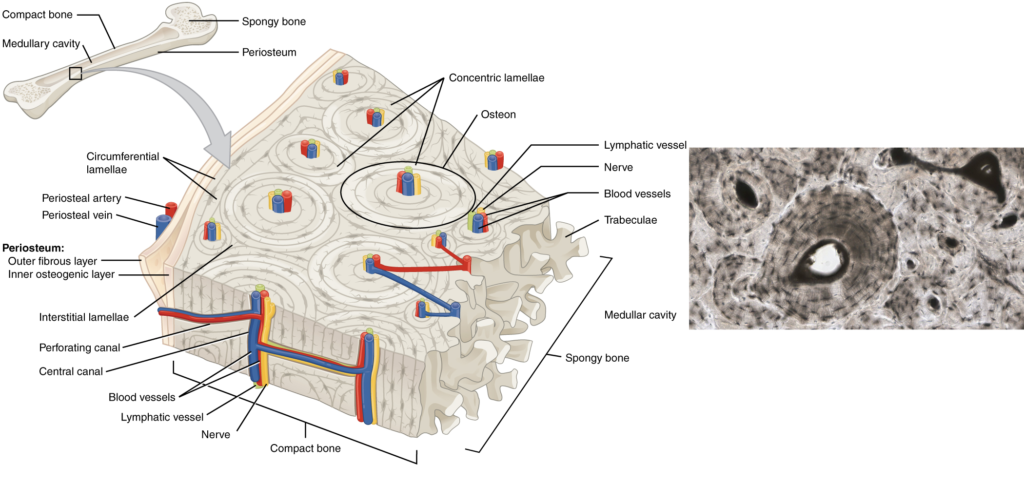
Effigy 6.ii. The structural features of compact bone.

Figure vi.3 The structural features of spongy bone.
Lab six Exercises 6.2
The teacher will provide you lot with a plastic model of enlarged bone tissue. Detect all the post-obit items in the model and exist prepared to bespeak out any three to the teacher on their request.
compact bone spongy bone lacuna canaliculum
central canal perforating culvert lamella circumferential lamella
trabecular periosteum endosteum os marrow

Figure vi-four The model of enlarged bone tissue you lot will use to identify the histological features listed above.
Source: https://courses.lumenlearning.com/ap1x94x1/chapter/compact-bone-spongy-bone-and-other-bone-components/

Postar um comentário for "What Differences Between Compact and Spongy Bone Can Be Seen With the Naked Eye"