What Happens if You Take a Baby Bird Out of Its Nest
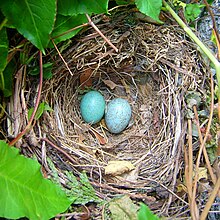
This is a blackbird nest. In one case the eggs have hatched and are gone, the bird will no longer utilise the nest.
A bird nest is a place where a bird lays its eggs. At that place are all kinds of nests, including cup nests, holes in the ground, and piles of twigs and leaves. The word can exist used as a noun or a verb, as in – a bird nests in a nest. They are in all kinds of sizes: some tin be as large and heavy equally a auto, like an old eagle'southward nest, while some can be tiny as a thimble, like the nest of a Bee Hummingbird.
Making a home [change | change source]
Ordinarily, the female person builds the nest, and the male helps her. In some species, though, the male does nothing, and in others, the male person builds the nest and the female does zippo.
Many birds "glue" their nests together with materials like spider webs, silk, mud, and even their own saliva (spit). Virtually nest builders like to put soft things within their nest. Some birds even put herbs and spices in their nest. Scientists think these herbs help fight off bacteria in a manner they can't completely empathize however.[1]
Types of nests [modify | change source]
Cup nest [change | modify source]
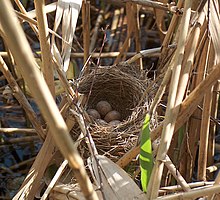
Cup nest of the Cracking Reed-warbler

Cup nest of a Redwing, with infant chicks. Almost all birds build cup nests like this.
The cup nest is probably the most common bird nest. Its name tells you that a cup nest is shaped like a cup or bowl. Many songbirds built cup nests. These nests can be congenital in the branches of a tree, similar in the crack where one branch joins another: all the same, some can but stick the nest right onto the branch of a tree. They use lots of materials that act like gummy glue – mud, rotten wood, dung, spider webs, and caterpillar silk.[2] [3] They sometimes even apply their ain saliva mixed with food to go along the nest firmly stuck on the branch.[iv]
Loving cup nesters use all kinds of materials to build a nest: twigs (tiny branches), grass, leaves, moss; and they utilize all sorts of materials to keep it from falling apart. Near cup nesters use rough, scratchy fabric for the exterior (this gives protection and camouflages the rest), and put soft, cozy material like moss, fur, feathers, and cotton on the inside.
Many cup nesters enjoy nesting very shut to the ground in low bushes – sometimes they will fifty-fifty nest in potted plants on a porch. Some of them actually just build their nests on the footing. Sparrows, cardinals, and many other vocal birds (chosen passerines), like to nest near the footing, far away from owls, hawks, and Blue Jays that may eat their babies.
At that place are several types of cup nests. A suspended cup nest is attached to the co-operative at the top and sides but and then drops like a bag down below. It actually looks more like a vase than a cup. The bird is almost hidden when she warms her eggs. The mother bird can sit downwardly on the co-operative to a higher place the nest and curve down to feed her babe birds. Orioles are very famous for edifice amazingly long numberless that hang far below the branch.
The smallest loving cup nests are fabricated by hummingbirds. They tin exist every bit tiny as a thimble, like the Bee Hummingbird's nest. That tiny nest holds eggs that are as tiny as peas. The largest cup nest is probably the stork'southward. His nest can be ix feet deep and 6 feet wide. The stork's nest is so big that smaller birds really make nests in its cracks, holes, and branches.[5]
Adherent nests [modify | change source]
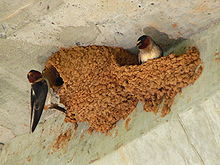
Two Cliff Swallows making mud nests. Find how the nest sticks to the wall of this building.
Adherent nests adhere (stick) to buildings, trees, cliffs, or other vertical structures. Swallows can build an most perfectly round nest out of mud. Some species make cup-shaped nests, while others make jug-like nests with little holes in the sides. They put niggling balls of mud in their mouth and mix it with their saliva, making a special clay. As information technology dries, it becomes hard.
Bird saliva is very practiced for making mucilage: in fact, some species of swiftlets brand their whole nest out of simply saliva. The male regurgitates (throws up) a long, thin strand of saliva from glands under its tongue. This saliva is used to exist made into a one-half-cup nest which sticks to a cavern wall (swiftlets like to build their nests in caves and grottos) and dries quickly. This saliva nest is idea to be a delicacy (something really yummy to eat) in China, and it is very expensive. They put it into a soup called Bird's Nest Soup.
Platform nests [change | alter source]

Nest of Polemaetus bellicosus (Martial Eagle)
Platform nests are built by and large by raptors (birds that eat prey, like eagles and hawks). They are usually huge and very, very high up - on the sides of cliffs, mayhap, or high up in a big tree. Information technology takes months and months making these nests, calculation branch by branch. They ofttimes return to the same nest yr after year and continue to build it. It is because of this that platform nests get so large: a Bald Eagle'south nest, for example, can weigh as much as a ton (about the same weight equally a small car). Information technology is so heavy it can sometimes hurt the tree information technology is built in.
A few water birds (similar grebes and loons) build platform nests correct on the h2o, where they can float. The nests don't move, though, because they are anchored to plants that are attached to the bottom of the trunk of water. These birds build nests on water because they don't walk well on land, then they discover a shallow (not deep) part of the water to build their nests. And then, they exercise non walk to their nests - they swim to information technology. When the babies are ready, they simply jump into the water and begin their aquatic (water) life.[iv]
World-pigsty nests [change | change source]

Farne Islands Puffin in couch
Earth-hole nests are nests that are within the earth. They are burrows (tunnels) on the ground or in the sides of cliffs. They like using abandoned rabbit holes, too. The Burrowing Owl but uses already dug holes for its nest.
Puffins, for instance, dig a tunnel that is usually 2 to three feet long. At the cease they make a nest of feathers and grass and lay their eggs. They are able to exercise this because of their sharp nib and claws. A puffin can work for hours to brand its tunnel. Kingfishers, also, dig or burrow their holes. They can burrow upwardly to half-dozen anxiety into the side of a cliff and lay their eggs in that place.
Ground and mound nests [change | modify source]

Many birds nest correct on the ground. After carving out a little hole, ground and mound nesters line the nest with grass or other materials. Geese even pick feathers from their breasts and make a nice downy bed for their eggs. Most ducks, geese, and quail similar the ground for nesting. Penguins nest on the basis, as well, pushing rocks effectually the nest to go on it from washing away with alluvion waters. Unremarkably, males make basis nests.[six]
The Trumpeter Swan makes a big mound nest, and flamingos make mounds, likewise. Flamingos make their mounds completely out of mud. They can be up to xviii inches high and 12 to 20 inches in width.
Scrape nests [change | change source]
These nests are barely a nest at all – merely a small depression in the basis or a pile of dead leaves to lay eggs on. These scrape-nesting birds ordinarily take eggs that friction match the color of dead leaves or rocks. This is needed because these eggs are in danger of being eaten past animals similar rats, raccoons, snakes, and others that swallow eggs.
Many scrape nesters actually try to distract creatures that might be dangerous by pretending they have a cleaved wing. This makes a predator hunt the mother bird, and leave the eggs.[7] [8]
Other [change | change source]
- Nest
- Egg (biology)
- Bird
- Plume
- Flight
References [change | change source]
- ↑ Fulbright, Jeannie K. (2005). Exploring Creation with Zoology 1 . 1106 Meridian Plaza, Suite 220: Apologia Educational Ministries, Inc. p. 74. ISBN1-932012-61-iii.
{{cite book}}: CS1 maint: location (link) - ↑ Ehrlich et al. 1994, p. 445 harvnb error: no target: CITEREFEhrlichDobkinWHeyePimms1994 (help)
- ↑ Erickson, Laura (Bound 2008). "The Wonders of Spider Silk". BirdScope. 22 (2): seven.
- ↑ 4.0 4.1 Fulbright, Jeannie Yard. (2005). Exploring Creation with Zoology 1 . 1106 Tiptop Plaza, Suite 220: Apologia Educational Ministries, Inc. p. 82. ISBN1-932012-61-3.
{{cite volume}}: CS1 maint: location (link) - ↑ Fulbright, Jeannie K. (2005). Exploring Creation with Zoology 1 . 1106 Tiptop Plaza, Suite 220: Apologia Educational Ministries, Inc. p. 83. ISBN1-932012-61-3.
{{cite book}}: CS1 maint: location (link) - ↑ Elliott 1994, p. 288 harvnb fault: no target: CITEREFElliott1994 (help)
- ↑ Campbell & Lack 1985, p. 145 harvnb error: no target: CITEREFCampbellLack1985 (aid)
- ↑ Fulbright, Jeannie 1000. (2005). Exploring Creation with Zoology ane . 1106 Meridian Plaza, Suite 220: Apologia Educational Ministries, Inc. p. 78. ISBNane-932012-61-3.
{{cite volume}}: CS1 maint: location (link)
Other websites [change | change source]
 Media related to Bird nests at Wikimedia Eatables
- (Pictures of Bird Nests)
Source: https://simple.wikipedia.org/wiki/Bird_nest

Postar um comentário for "What Happens if You Take a Baby Bird Out of Its Nest"